Season 4 Wrap Up: The Founder Spirit Podcast
An entrepreneur at heart, Jennifer Wu is a business executive with over 20 years of experience in financial services, strategic consulting and startups across the United States, Europe and Asia. She is also a curious explorer of spirituality, self-discovery and human transformation, and believes that the meaning of life is to constantly improve yourself.


About The Episode
In this episode of The Founder Spirit, Jennifer shares her key takeaways at the end of her fourth season - music as a healing modality, the importance of gratitude, what it means to be a "good ancestor," and why humanity needs to be at the center of technological development. She also opens up about launching Unity4Impact, a new venture, becoming an empty nester, and the need to slow down in the accelerating age of AI.
Here’s to continuing to explore what it truly means to be a founder - not just professionally, but of our own lives. Thank you for being part of this journey. Stay tuned for Season 5!
Biography
An entrepreneur at heart, Jennifer Wu is a business executive with over 20 years of experience in financial services, strategic consulting and startups across the United States, Europe and Asia. She is also a curious explorer of spirituality, self-discovery and human transformation, and believes that the meaning of life is to constantly improve yourself.
Episode Transcript
[00:02] Jennifer: Hi everyone, thanks for listening to The Founder Spirit podcast. I'm your host, Jennifer Wu. In this podcast series, I interview exceptional individuals from all over the world with the Founder Spirit, ranging from social entrepreneurs, tech founders, to philanthropists, elite athletes and more. Together, we'll uncover not only how they managed to succeed in facing multiple challenges, but also who they are as people and their human story.
Our podcasts are shared freely with the public, and your generosity is highly appreciated as we decided to do away with corporate sponsorships a few years ago. Please consider supporting us on Patreon so that we can continue creating meaningful episodes with inspiring guests - that is P-A-T-R-E-O-N.com/TheFounderSpirit.
As always, you can find us on Apple, Amazon and Spotify, as well as social media and our website at TheFounderSpirit.com.
Once again, thank you all for tuning in and I really hope that you’ve enjoyed the 4th season of The Founder Spirit podcast. If you’d like to hear a bit more about my key takeaways from this season, personal challenges that I had to overcome, what I think of the accelerating development of artificial intelligence, feel free to listen to this season’s wrap-up conversation with my friend Ingrid.
[01:30] Ingrid: Hi Jennifer, you've just finished season four and once again we've been treated to an amazing list of guests. How have you experienced this season? Like, from your perspective, what has it been like?
[01:43] Jennifer: First of all, Ingrid, thank you so much for doing this again with me. I always really enjoy doing this end of season wrap up with you because it allows me to reflect on the work that I've been doing the last year.
How did I experience the season? As you know, there's been quite a bit of ups and downs in my life in the past year. As I've decided at the end of last year to launch a new venture, one of the questions that have come to me is whether or not I should keep doing the podcast or if I should pause it.
I've decided that I would continue but maybe slow down the cadence. So instead of doing it every two weeks, I would maybe do it every three or four weeks. I think personally there's always a bit of self-doubt when you're in the process of creation.
For me, I find that I'm questioning sometimes, like now I've done it for four seasons, does it still make sense? Are the messages overdone? Is there a better use of my time?
In the end, doing the preparations for the podcast guests and learning about their journey and then getting feedback from the audience keeps me motivated and keeps me going, which is also one of the reasons why I decided to continue.
Although because I'm starting a new venture, I won't be able to be as prolific as I had been in the past. I hope that answers the question.
[03:09] Ingrid: Yeah, absolutely. So you featured three people who have made music their career. Is this a coincidence or have you been particularly touched by music recently? And could you tell us also what you learned from these musicians specifically?
[03:24] Jennifer: Yeah. So for me, it's a pure coincidence. Now that you mention it, I actually had to go back to the podcast guest for the season. Yes, it's true. I've had three musicians.
The season started with Songha Choi, who's a violinist. And we also featured Dana Leong, who's (an) exceptional and two-time Grammy-winning electric cellist, but he's really multidisciplinary.
And the last musician I had on the show is Eric Genuis, who is obviously a composer and virtuoso pianist who plays in prisons for people on death rows, at inner city schools and rehab centers. It was by pure coincidence that I had three musicians on the show.
If I think about all the three people that I've had on the show, the theme is really around healing, how music can heal. And I think it's especially evident in the work that Eric and Dana do. Yes.
There are people that have been transformed by the music that they've played. So the lesson is, in addition to whatever therapy that you might be seeking, I think music can be very healing.
[04:43] Ingrid: It's good vibrations.
[04:44] Jennifer: Yeah, good vibrations. And also I think music has a higher purpose than just entertainment. And that's quite evident in the three separate conversations that I've had.
[04:56] Ingrid: You seem to be pursuing your aim of exploring a life of the spirit yourself. And you actually interviewed this season a Buddhist monk and an ISKCON swami.
Can you tell us which wise lessons will stay with you from those episodes?
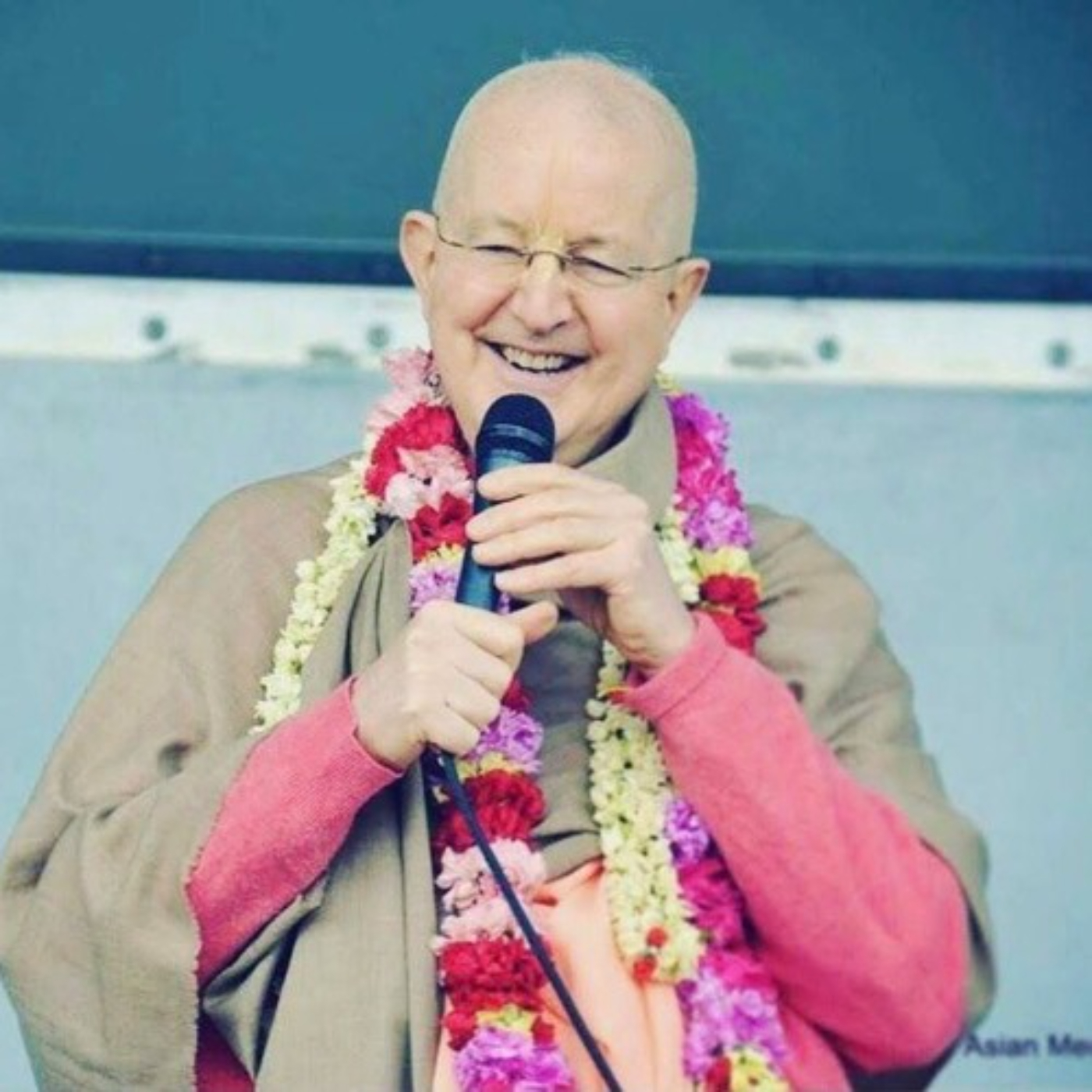
[05:11] Jennifer: Well, I think it's very interesting. Obviously Romapada Swami is a spiritual guru, and Shoukei, on the other hand, is a Japanese Buddhist Monk. He's a monk entrepreneur, he's more secular, he has a family, kids.
From Romapada Swami, we talked a lot about love and gratitude and devotion, because that's particularly accentuated from the faith tradition that he comes from.
Obviously, one of the things that really stuck in my mind is he said gratitude is the seed of love and purity is what moves it in the right direction. And as you know that I recently went to a bhakti yoga retreat, which I found to be very interesting.
And bhakti, from what I understand, means love and devotion. And he emphasized a lot about putting God at the center of everything. Obviously in the tradition where he comes from, it's Krishna.
And you and I have been studying the Bhagavad Gita - we reflect, we interpret the text, but it's really more left-brained, from an intellectual, maybe theological perspective, definitely for you.
But to experience what it means to lead a life of devotion and service, yeah, you'd have to experience it among the community.
[06:42] Ingrid: Yeah. You said that you were very struck by the joy.
[06:46] Jennifer: Yeah, yeah, exactly. So I went to the retreat just for the day, but I left with a lot of joy and gratitude and a renewed sense of purpose.
[06:54] Ingrid: Interesting.
[06:55] Jennifer: I wanted to also talk about Shoukei. Shoukei translated the book Good Ancestor (by Roman Krznaric) into Japanese.
And we've had discussions (on) what it means to be good ancestors. And what he had said on the show is to be good ancestors means leaving a wider canvas for future generations.
That actually reminded me of some of the Indigenous principles, which is the idea of seven generations. Right, you have to think about our actions in terms of what consequence it could have for seven generations or for the seventh generation.
And this morning I was just exchanging a text message about the fossil fuel industry and the degradation to the environment that we have caused. And he says well, let's just party and enjoy the show.
And that's exactly the dominant narrative in the society that we have is we don't think of the consequences down the road. It happened with social media. It's happening now with AI.
So because we often live our lives in a very egotistical way, we don't think about what consequences I (am) creating for others, I mean, beyond our immediate family and circle of friends.
And that is, I think, one of the reasons why we have all the problems that we have today, may it be social division or war and conflict. So that's one of the things that I learned from Shoukei.One of the things that Romapada Swami and I spoke of is also.
So I happened to interview him in mid-March, and it was a couple of weeks after the war had just started in the Middle East. And I asked him to compare and contrast the battle in the Bhagavad Gita to what is happening in today's context, meaning today's war.
And he said, and I think that this is something that most people need to think about, is that the battle on the Kurukshetra, which is where the battle took place in the Bhagavad Gita, is a battle about Dharma - it's about restoring natural laws.
Whereas in today's war, it's about ego. You know, we're not putting the natural law or the natural order or God at the center. The reason why we're fighting is because of ego and greed, and we want to claim more territories or destroy others.
Gosh, I'm usually not this political, but okay, I guess this is where I am.
[09:35] Ingrid: I'm impressed that you're willing to venture into this territory. (chuckles)
Well, I'm not sure this is quite a segue, but I was going to ask you, because actually, one of the defining aspects of your show's guest is that they are not just working for themselves, their ego, their money.
They all have a bigger vision, whether it's building bridges among people or working for conservation or peace or social change. So I guess that's like the founder spirit involves working for something bigger than yourself.
[10:11] Jennifer: Yes, I think it's not just the founder spirit, actually. It's that I am learning to be of service. So it's more than just the podcast.
When I started the podcast, we did the first trailer, we talked about what is the objective. And I told you that it was to help other people, to get the lessons and the message out there that I've learned throughout my life.
And it should be everything that I do with intention, and I think everybody should strive to do that.
[10:29] Ingrid: Well, I know you've been developing a new venture which also follows this pattern of working for something larger than yourself. So maybe you can tell us a little bit about Unity4Impact.
[10:44] Jennifer: Sure. So Unity4Impact is a Swiss nonprofit organization that I'm launching as we speak.
It is a collaborative platform to mobilize funding across the capital stack by connecting qualified funders with high impact organizations, both nonprofits but also for-profit social enterprises around the world. The initial focus is going to be on climate/nature, as well as education and livelihood.
So it's an idea that came to me, I have to say, while I was doing the post-production of Jay Cziraky episode on the No-End Philosophy, where he mentioned several times that “the pathway of funding doesn't exist, the pathway of funding doesn't exist.” And that really resonated with me.
Of course he was talking about something else, but having sat on boards of nonprofits for over a decade, I think that message really resonated with me because I understand from the social entrepreneur perspective that they often end up spending the majority of their time fundraising versus building capacity and focusing on operations. So I think that inspired me.
We will be running pilots for the next nine months and a lot of my own hypotheses will need to be proven out. Everyone seems to like the platform and we'll see on the funder side if there's going to be any uptake.
And also how do we activate the community from an online perspective and also (with) offline events, and how do we really connect people in this global community of impact.
[12:35] Ingrid: Sounds like a very exciting project. A lot of work.
[12:39 ] Jennifer: Well, yes, it'll be a lot of work. This is for sure just the beginning, and it'll take a few years to build up a curated community.
[12:46] Ingrid: So you've been doing all that while also seeing your kids off to university and breaking a leg,.
[12:55] Jennifer: Literally… (chuckles)
[12:56] Ingrid: Yeah, exactly. Tell us a little bit about your personal challenges this year.
[13:01] Jennifer: Yeah, we became empty nesters as of last fall, which I feel like I transitioned quite well into. Because I had already seen it coming and I prepared myself for it, so I mourned the loss of having my children at home already ahead of time. Breaking a leg, that was tough. (chuckles)
[13:22] Ingrid: Did you see it as a spiritual lesson?
[13:24] Jennifer: I don't know. Maybe at times I had to motivate myself to think that way. But yeah, I had a ski accident, I fell in a very traumatic way.
The doctors have compared my injury to Lindsey Vonn (US Olympian), though it's not as bad. But I have to say I'm recovering quite well. There was no damage to the knee. I just have to deal with a stiff leg for the time being. I got off crutches pretty quickly.
I have to say at some point that I was holding on to a lot of anger and I had to slow down. Since the beginning of this year, I have been running a mile a minute, I would say.
[14:01] Ingrid: So you were forced to slow down?
[14:03] Jennifer: Yeah, the universe was just like, you need to take a break. And I think because I was really tired as well, I didn't get proper rest. That's also why I fell.
I was speaking to a good friend of mine earlier this week. He's doing a new initiative and creating an Institute for Forest Wisdom. But he said, it's coming along very slowly and sometimes we have to learn that things may not unfold as quickly as you like to.
So I think I just had to slow down. I had to take time out for myself. That's an important lesson. Sometimes when you're in the middle of everything, you just forget to take care of yourself. So making sure that one is centered, I think, is really important.
[14:46] Ingrid: It's a good reminder indeed. We touched upon AI briefly already. But anyway, it's impossible to have a conversation these days without someone raising AI.
So what's your feeling about the way the future is unfolding and how do you think AI will affect humanity? Are you worried for your kids?
[15:03] Jennifer: Interesting you mentioned that because obviously I recently released an episode with Michael Clark called Unlocking Human Potential in the Age of AI. He's also the author of the book called Our Moment.
And I agree with him because I do feel like that we're standing at the fork of the road, and the directions that we choose now given the development of AI can have consequential effects on humanity.
If you look at it from China's perspective, there has been a law in place where companies cannot fire people due to AI. And you see quite the opposite that's coming from the US.
And so Michael and I talked about really like, how do we put humanity at the center where AI becomes a tool, it becomes an input, becomes a partner, a colleague maybe, but it is an input, not an output that we rely on.
And one of the things that my classmate from business school, Alvin Wang Graylin had mentioned is that we are taking two very different approaches, or China, US has quite two very different approaches because the American labs are really looking to develop the next pioneer model to replace cognitive labor market, which is a $30 trillion market, which is also now why you're seeing just huge valuations in AI.
Whereas the Chinese models are smaller, they're looking to build sovereign AI models., meaning, a specific company or specific country can have their own AI model that's adapted to their own data and circumstances.
And he is of the opinion that the God model, as he calls it, is still speculative whether or not we'll actually get there with…The American model? Yes, with the current development in AI.
But the question always comes back to me is like, how… is that we need to put human at the center? I don't necessarily buy into Elon Musk's vision that, oh, it will be the age of abundance. I think you can say that when you're a billionaire and that robots and machines will do everything, you know, people will get a universal income.
Is that the future that we want to build, though? Is that the world that we want to live in? I think a lot of times we live in a society where technological development is being upheld as human progress. And we don't think through the second and third order effect of what it might have on society.
[17:57] Ingrid: We don't think seven generations down the line.
[17:59] Jennifer: No, we definitely don't think seven generations down the line.
But I do think that, as I mentioned before, we need to slow down, so that we have room to breathe, so that we can think about the potential consequences that this technology can bring.
Maybe going fast is not the best way because look what happened to social media, what it has become and all the mental health problem that it’s causing among teenagers who don't have a fully developed prefrontal cortex.
I know it's that the Silicon Valley model is (to) move fast and break things, but when you're on the spiritual path, you understand how important it is to slow down.
[18:39] Ingrid: Yeah. And avoid what the French call "la fuite vers l'avant" - fleeing ahead, which is completely counterproductive. Yeah. It's quite scary. All in all, I would say.
[18:51] Jennifer: I think one of the things is we don't observe nature, right?
So speaking of slowing down, we saw what happened during COVID 2020. Nature came back to life. We just need to give her a break. But she came back to life during the lockdown.
And same with humans. People are overworked, that we over-analyze, we overthink, we over-worry about many things…
[19:17] Ingrid: we over-consume and we over-consume.
[19:21] Jennifer: And we just need to slow down. That's it.
I have to say, I also have to constantly remind myself of doing that because I'm not very good at doing that either.
[19:30] Ingrid: But when the general trend is in that direction, you sort of…
[19:34] Jennifer: Yeah, I feel like the world is accelerating. Not just with AI, just everything is accelerating.
And with AI, there will be tremendous increase in productivity. And that means within the same amount of time, we're capable of doing more things with AI. So I'm thinking, is that really beneficial also from our mental health perspective?
So if you think about before the Internet, we had to call people up, things would take a week to get done. With the Internet, it would take a day. And now with AI, it's maybe an hour.
So that means that we'll have a lot more time to do other things. So I feel like we are more productive, but we're even busier.
[20:23] Ingrid: Yeah, it's true.
[20:25] Jennifer:Yeah, we are busier. It hasn't bought me free time. I'm more productive, but I'm certainly busier.
And so I'm thinking now with AI and the way that it's able to really bring up productivity at an unprecedented rate, what kind of result it would have on our mental health. And also because our brain…
[20:47] Ingrid: cannot function at that speed, we're not meant to…
[21:49] Jennifer: No, at least my brain can’t, maybe the younger generation can.
[20:52] Ingrid: But it's interesting because your podcast is all about human speed, right? Sitting down to have a conversation, asking questions, debating.
And actually, I think that's what really makes sense to a lot of people, is really to live on that scale and that speed that our brains are designed for. And all these technological advances are counter to our nature.
[21:19] Jennifer: Like I said before, we now equate technological development with human progress. That's not necessarily the case.
If anything with AI, I feel like that we're going backwards because we rely on the machine to do a lot of the cognitive functions. So I think we really have to think about how we use AI, what kind of effects it's going to have on the labor market and what it means for our kids.
You know, of course they're scared. Already there's not that many jobs available, perhaps the safest ones is a plumber or electrician.
So if you have the top labs that are working towards replacing the cognitive labor market, yeah, it's a scary thing. But I think the jury's still out whether or not they will be successful.
I think we're going through a transition now, not just with AI, but also with many of the other challenges that we have - with climate, with ourselves - we have a lot of mental health challenges.
This is a culmination of the damages that we're causing to the environment, to each other, to ourselves. So I think all that is now surfacing in the world as division and violence.
[22:30] Ingrid: Do you have any guests lined up for next season then already?
[22:33] Jennifer: Yes, I do. I decided to continue and I lined them up so I can't chicken out. (chuckles)
So I think the first guest that I will have is Ashish Goyal. He is a dear friend and he is the first blind trader on Wall Street. I think he has (had) this condition since he was 7 years old, and then he became blind when he was 18 or 19.
So he went through this excruciating period of 12-13 years of losing his sight slowly. So I think that'll be very interesting. He recently did a 20-mile walk around London and raised £70,000 for his charities. So I'm really inspired by him as a person and also the work that he does.
The other guest that I plan to have on the show is Dr. Lisa Miller, who is a professor and the founder of Spirituality Mind Body Institute at Columbia University. So she's someone (who's) studied the science of spirituality for most of her life.
So she'll be another guest on the show and then we'll see how the season evolves. But I didn't plan too many (guests) in advance.
[23:47] Ingrid: Okay, one last and possibly strange question. If you had yourself on the show, what would be one or two questions that you would like to ask yourself?
[23:56] Jennifer: I think I would like to ask what were the people that had the most impact on your life?
[24:04] Ingrid: And you would reply?
[24:06] Jennifer: I think there were three people that really had a huge impact on my life.
One was Anita. I met her when I was 17 years old, and I was a very shy teenager. And she was the opposite. She was smart, she was outgoing, she was confident. She was everything that I wasn't at that time. And being around her really showed me and elevated me to what I could aspire to become.
The second person I would say is my first boss out of college, when I became a consultant in New York City. I think there are certain people in your life that really believe in you more than you believe in yourself at that moment.
So he's been my lifelong mentor. We're still friends. He really boosted my confidence professionally versus my friend Anita boosted my confidence personally. And I think the third person is my former CEO, Nathan Anderson, my second podcast guest on the show.
I think he showed me a different way of being. When we work together, we often face the same challenges, but he had a different way of looking at these challenges. And he had the confidence that things would evolve and it would work out, that he never took these challenges as something that was fixed, but he took it as something that was fixable.
It was a different state of being. He was obviously optimistic. I mean, you’d have to be, as an entrepreneur. But he saw beyond the problem at hand, whereas in I just saw the obstacle.
I'm super grateful having had these three people in my life, that’s besides my husband and my children.
[25:50] Ingrid: Of course. Was it not on your show or somewhere else? I just heard recently a quote from Bruce Lee, be like water. It's like an unstoppable force, and it just finds all the cracks in the…
[26:06] Jennifer: Yeah, well, it's also like having the belief that everything will work out.
And that's also how people manifest, you know, because if you're stuck, you can't manifest. You have to first embody the emotions as if they had already been happening.
[26:26] Ingrid: Very nice. Well, that's a nice way to wrap up.
[26:28] Jennifer: Yes. Thank you.
[26:30] Ingrid: I look forward to next season.
[26:31] Jennifer: Thank you, we'll see where it goes. Thank you so much.
Our podcasts are shared freely with the public, and your generosity is highly appreciated as we decided to do away with corporate sponsorships a few years ago. Please consider supporting us on Patreon so we can continue creating meaningful episodes with inspiring guests - that is P-A-T-R-E-O-N.com/TheFounderSpirit.
As always, you can find us on Apple, Amazon and Spotify, as well as social media and our website at TheFounderSpirit.com.
[27:14] END OF AUDIO
Show Notes
Social Media Links:
- Website: https://www.thefounderspirit.com/
- LinkedIn: https://www.linkedin.com/company/TheFounderSpirit/
- Instagram: https://www.instagram.com/thefounderspirit/
- YouTube: https://www.youtube.com/@TheFounderSpirit
- Apple: The Founder Spirit Podcast
- Spotify: The Founder Spirit Podcast
- Amazon: The Founder Spirit Podcast