Stanzin Gya: Living with Change in the High Himalayas
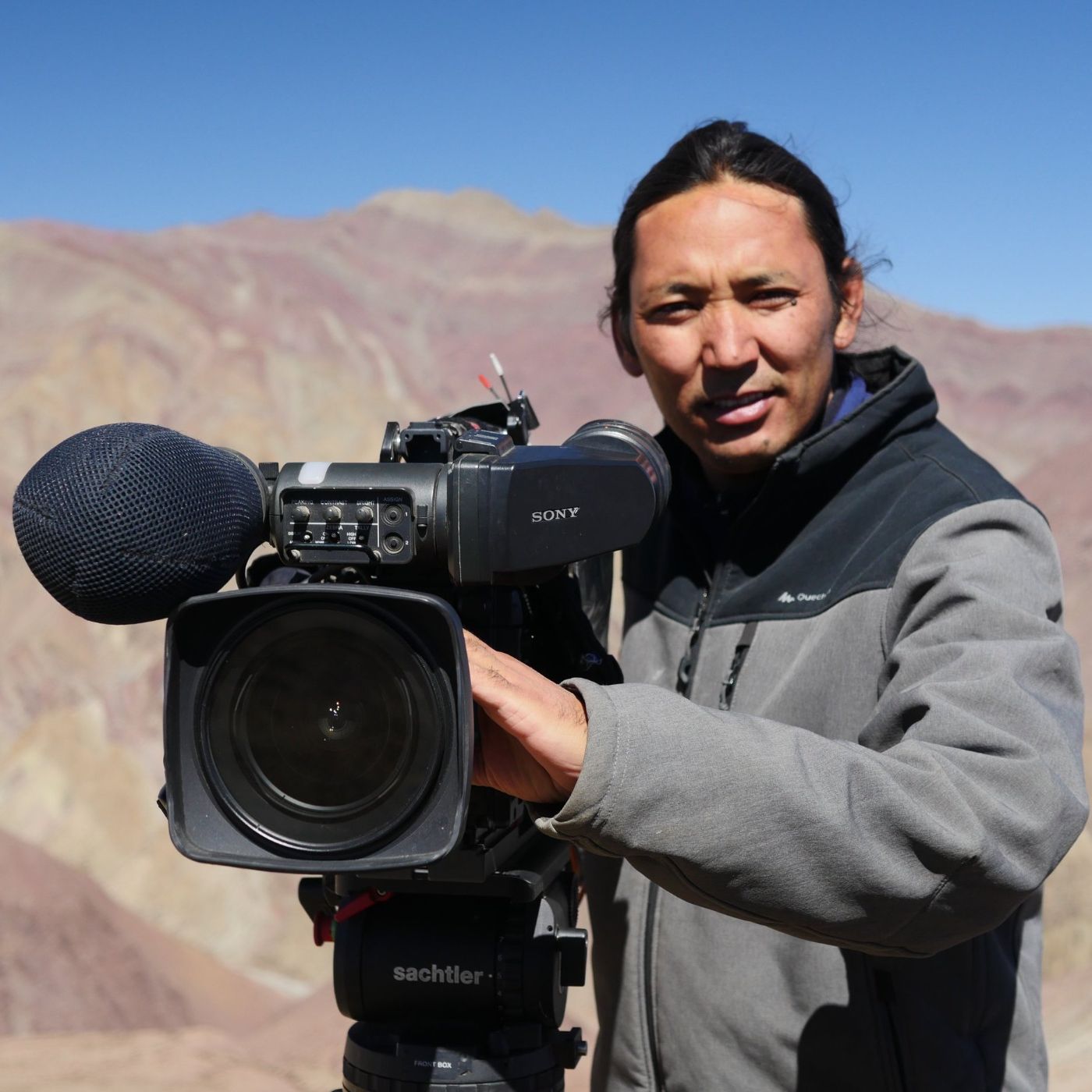
Stanzin Gya is a storyteller, an award-winning documentary maker from Ladakh, India, and founder of the Himalayan Film House. Having recently released his 21st film, he is dedicated to sharing tales that open the viewers’ eyes and hearts to the unique challenges of life in the High Himalayas.


About The Episode
Join us on The Founder Spirit podcast with Stanzin Gya, whose films are a testament to the power of storytelling rooted in truth and authenticity—giving voice to the High Himalayan communities and their urgent ecological concerns. His journey from shepherd boy on the Tibetan plateau to global storyteller encapsulates the resilient human spirit and unyielding hope for a sustainable future.
Stanzin shares how documentaries became his tool not just for storytelling but for activism, after witnessing the devastating flash flood in 2010 that threatened both ecosystems and communities. His films, like Shepherdess of the Glaciers and Living with Change, illuminate the urgency of climate action and the importance of preserving indigenous wisdom and eco-heritage. Through his lens, you'll learn how truth, authenticity, and respect for nature can spark real impact.
How did Stanzin, who grew up without a television, rise to become an award-winning documentarian? Well, let’s talk to him & find out. Don't forget to subscribe and support us on Patreon!
Biography
Stanzin Dorjai Gya, a filmmaker living in Ladakh, India, is dedicated to sharing stories that open the viewers’ eyes and minds to the unique challenges of life in the High Himalayas. His subjects are as compelling as the landscape. His message is as profound as the surrounding mountaintops.
Stanzin Dorjai Gya hails from a remote village in northeastern India situated at more than 15,000 feet (over 4,500 meters) in the High Himalayas. Like other children of Gya Village, Stanzin had a semi-nomadic childhood, spending half of the month tending his family’s herd of yaks and cashmere goats, while attending school during the other half.
In 1995, unable to pass the necessary standardized tests to complete high school, Dorjai began attending an alternative school, SECMOL (Students Educational and Cultural Movement of Ladakh), dedicated to teaching students in a non-traditional setting (the students have built the campus themselves using environmentally-friendly materials).
Learning more about the visual medium, SECMOL ignited Stanzin’s passion for film. There he was able to watch more documentaries, and meet people from the film industry, including Indian filmmaker Lena Tace and Lars Lidstrom from Sweden, as well as his mentor, Mumbai-based Director Rahul Randaive.
In 2000, Dorjai worked as editor, executive producer and cinematographer of Tsondus, which is his first feature film. In 2005, Dorjai received his Bachelor of Arts degree from Jammu University. In 2006, he founded the Himalayan Film House in Leh, wherein he has directed and produced feature films and documentaries on regional, national and international issues. In 2007, Mig choo became the first film made by the studio.
Later, he met Christiane Mordelet, a French filmmaker, and has henceforth worked in close collaboration with her, together producing internationally-acclaimed, award-winning films. The founder of the Himalayan Film House in Leh, Stanzin has directed and produced notable feature films and documentaries on regional, national and international issues.
In 2008, Stanzin Dorjai Gya and Christiane Mordelet created “Living With Change” a documentary produced for the World Wildlife Fund (WWF) India about the effects of global warming in Ladakh, earning international awards.
In 2012, Himalayan Film House in collaboration with Lato Sensu Production house in France produced “Jungwa: The Broken Balance," a remarkable documentary based on the August 2010 flash floods which devastated Leh. The film earned numerous awards across international platforms, including Banff Mountain Film Festival before being selected for screening at the United Nation’s COP21 Paris Conference in 2015. “Jungwa” and “Living with Change” were both shown at COP21 and became critical messengers of what Ladakh and the Himalayan region have gone through due to climate change.
His recent documentary, “The Shepherdess of the Glaciers” pays homage to his sister’s life in carrying forward his family’s solitary nomadic way of life as shepherds working high in the High Himalayas. Braving temperatures of -32 °C, heavy snowfall and a 30 kg load of film equipment at an altitude of 16,000 feet, he has told his sister’s story with unfiltered honesty and compassion. The documentary has received more than 20 awards, both at home and abroad, with the highlight being the Grand Prize at the Banff Mountain Film Festival in 2016.
In 2019, Dorjai was chosen as the District Youth Icon (Leh) by the Election Commission of India, during the Lok Sabha Elections.
Episode Transcript
[00:02] Jennifer Wu: Hi everyone, thanks for listening to The Founder Spirit podcast. I'm your host, Jennifer Wu. In this podcast series, I interview exceptional individuals from all over the world with the Founder Spirit, ranging from social entrepreneurs, tech founders, to philanthropists, elite athletes and more. Together, we'll uncover not only how they managed to succeed in facing multiple challenges, but also who they are as people and their human story.
Our podcasts are shared freely with the public, and your generosity is highly appreciated as we decided to do away with corporate sponsorships a few years ago. Please consider supporting us on Patreon so we can continue creating meaningful episodes with inspiring guests - that is P-A-T-R-E-O-N.com/TheFounderSpirit.
As always, you can find us on Apple, Amazon and Spotify, as well as social media and our website at TheFounderSpirit.com.
“I (grew) up with my family, with open valleys and with the sheep and goats is my school. My friends are snow leopards, wolves, eagles, and marmots. I don't have a big television screen - my screen is the Milky Way when I look at the star - very different than the modern world now.”
“In Ladakh we’ve seen lots of snow, but we never ever seen such rain continuously for 10 days. That night was terrible - suddenly (a) flash flood. Even I can hear so many people were saying I'm in the mud, help me, help me. Some of my friends are under the water, they (died) in front of me.”
Joining us today is the industrious Stanzin Gya, a storyteller, an award-winning documentary maker from Ladakh, India, and founder of the Himalayan Film House. Having recently released his 21st film, he is dedicated to sharing tales that open the viewers’ eyes and hearts to the unique challenges of life in the High Himalayas.
Closely attuned to the rare local wildlife and deeply knowledgeable about the rich Himalayan Buddhist tradition, his subjects are as compelling as the landscape, and his messages, as profound as the surrounding peaks.
The reason why Stanzin is on the show today is because a mutual friend introduced us after she had returned from tracking snow leopards in brutal conditions. I was equally moved by his critically acclaimed film, “Shepherdess of the Glaciers”, following his sister’s nomadic journey during the harsh winter, and touched by their connection to nature.
Just how did Stanzin, who grew up without a television, rise to become an award-winning documentarian? Well, let’s talk to him & find out.
Hello Stanzin, welcome to The Founder Spirit podcast! And thank you for joining us today all the way from the High Himalayas.
[03:23] Stanzin Gya: Thank you so much, Jennifer. It's my honor to be part of the Founder Spirit Podcast. I'm so happy to speak with you - thank you.
[03:34] Jennifer: Thank you, Stanzin. Growing up as a shepherd boy in the High Himalayas, what were the key influences on your life?
[03:43] Stanzin: Where I was born is very high altitude, like more than 4200 meter high, where I (grew) up with my family, with open valleys and with the sheep and goats is my school. My friends are snow leopards, wolves, eagles, and marmots.
I don't have a big television screen - my screen is the Milky Way when I look at the star - very different than the modern world now.
It was not easy, it was very tough. (At) 4200 meter high, air is very thin, to breathe is an effort. Sometimes you have to take care (of) your sheep and goats - it's very nice, very interesting. But living with that (is) also a challenging but very useful life.
So it's a learning experience, learning by doing. Everything, everyday - you are like a wildlife, you have to open your eyes, you have to sleep outside with the sheep and goats in winter, -20 to -25C. But all these difficult challenges make you very tough, and that is your story today.
I (grew) up in this valley called Gya-Meru Valley, one of the oldest villages in Ladakh. You have a semi-nomadic life, you have lots of barley fields. You have sheep and yaks and goats, and everything (is) interdependent.
We always say, this is ours - this is our sheep and goats, this is our mountain. Not I - not my sheep and goat - this is our sheep and goat. This is how we have to live with the animals and everybody in a very equal way.
[05:30] Jennifer: Thank you. It's such a beautiful picture that you painted with words about where you come from.
I know it's very harsh living conditions because obviously the winter is very long. You're living above 4,000 meters in the High Himalayas, and the summers are very short. When I watch your films, there's not a lot of stuff that grow there, and there's a lot of tending to the sheep and goats and the yaks.
And you had mentioned your friends are the snow leopards. I don't know how you become friends with a snow leopard because they're very very elusive animals, right?
But I was wondering if you can talk a little bit about your culture, what is the culture like for you and your people?
[06:10] Stanzin: Once you come to Ladakh, you will not feel like going back to your place. It looks empty, because it's a cold desert. When you look from outside, it look like nothing.
It's like exactly when you are in the Mediterranean Sea. When you are on the sea, you will not see anything, only water. When you go little deeper, like 10 meters or like 100 meter, 200 meter, there is a full of life, full of fish.
That is exactly Ladakh. Ladakh is like a moon land, it's very difficult. But that is the one thing which inspired me to make films. Because on this moon land, all our ancestors, without much tools, without any other experience, they made this moonland turn green, they make water, they make a nest. But more than that, they are always with kindness, very happy. So that is the Ladakhi culture
You will find this gigantic mountain in many places, in different parts of the world. But behind this mountain, how people live, that is the treasure to tell to the world. For example, you have very limited resources, but you have to be happy with that.
Why are you happy? Because you are not destroying the planet, because (the) air is so pristine, so clean, one of the purest air in the world. So this is how (it) is there.
When you go (from) one place to another, you are always (a) guest, oh, come to my home, have food, share your problem (with) me. To respect others, not to think individually - my, I - this is what our ancestors taught us generation to generation.
In this culture, somebody pass away suddenly because of (an) accident, because of any reason, the community will take care (of you), You know, that is still the culture in Ladakh. Yeah.
[08:14] Jennifer: Thank you so much. It's very similar to what actually Jaideep had told me about the people in the Himalayas. He said they're so friendly, you know, materially they don't have much, but if they have anything, they would give it to you. There's something to be said about the warmth of the culture in Ladakh.
Now I want to explore a little bit about the special school that you went to in 1995. Unable to pass the necessary standardized test to complete your high school, you attended an alternative school called SECMOL, which stands for Students’ Educational and Cultural Movement of Ladakh, which is dedicated to teaching in a non-traditional setting where it's mostly student-led. For example, the students built the campus themselves using environmentally friendly materials.
So tell us more about SECMOL and what makes it such an unusual school.
[09:14] Stanzin: This is a very special school when you have failed in your regular school
My schooling was very late when I was in the mountains. And that time 15 days (per month) I am taking care my sheeps and goats and yak in the mountain. And then (for) 15 days I'm going to school, read and write.
Science, math, physics is different because in Ladakh we have snow. So I have to study about the rain, so I never seen the rain before. We have a yak and sheep and goats, I have to study about the elephant and then fan. We have here -20c - what is a fan? I didn't understand and always thinking this (is) irrelevant.
So then I failed like three or four times in 10 examinations. But then I say like, okay, this is my life. Then I heard about this SECMOL - the Students' Educational and Cultural Movement of Ladakh, is (founded by) Mr. Sonam Wangchuk, who is an innovator, a teacher, and an engineer.
He's always saying it's not your (failure), the system (has) failed because system is not right for the right people. In this school, you have to wake up with the light - and use the resource also not to destroy the environment - whole campus is running with natural light.
And when you wake up, you have to do half an hour (of) meditation. So you have to be (introspective). But school is run by the students because they have to learn. Otherwise (it’s) only book knowledge, you have to memorize.
And then this school main motif is the 3 H’s - bright heads, skillful hand and then kind heart. Because in this world what till now we did is you are a very bright head, you are very intelligent, you can be a terrorist because you have a very good skill hand - you can make a bomb. You can make so many bad things till you don't have a kind heart.
Bright head, skillful hand, kind heart - that is what the global leaders need. But definitely in this school they tried to teach all these things.
[11:36] Jennifer: I love this new model for an academic institution which is helping kids who fail out of school and helping them to get back into life, but with practical skills, also a spiritual education.
You know, as you said, I think out of the three H's that you said - head, hand and heart, I think having a kind heart is the most important. Because if you don't have a kind heart, I think everything else, even if you have a bright head and skilled hand, you can still do a lot of damage in this world. So thank you for sharing.
It was at SECMOL where you were initially exposed to documentaries. I'm assuming you started watching documentaries when you got to the school which in turn ignited your passion for filmmaking.
And I was wondering if you can talk about what was it about your experience at that school that sparked something deeper and set you on this path of filmmaking.
[12:34] Stanzin: Yeah, till I was 13, 14 years old I never ever seen (a) television when I was a shepherd boy in the mountains.
When I was in SECMOL, the teacher, the guru Sonam Wangchuk, and Rebecca Norman and then Rahul Rana Dev - they say, Stanzin, you have a very good eye on media, why you not try to do something?
Then there are so many different volunteers coming from all over the world - they have a small camera. So I was just so curious, where do I get this camera now. Then they have one section called media section in SECMOL.
And during that time, Mr. Sonam Wangchuk - he has a mission. So he wanted to do all the education system change in Ladakh. He wanted to go in remote places, the last village and make a big campaign.
After 3-4 years we are part of this movement called Operation New Hope. So then we go to the village - one place to another place - it was very far. When you go one times all the villagers come to listen to you. And then second time when you go, they don't have interest to come again.
Then in SECMOL, we record the religious leaders, then we have two political leaders, then administrations - everybody makes a record. We make a very small editing. And then we go in again.
In the village we say oh, today we have a film in Ladakhi language. Everybody comes then like oh, the film is in Ladakhi. So from 80 years old people till the 3 years old, everybody is coming. So that night I felt (the) audiovisual is so powerful. This is not only entertaining, we can bring change through this audiovisual form.
Then I started dreaming, I wanted to do something like filmmaking. So then learning by doing, learning by doing - that’s how I got interested. And then I thought this is what I want in my life. So this is how I started coming into filmmaking.
[14:51] Jennifer: So you pretty much learned how to make documentary films by doing. Is that what you're saying?
[14:57] Stanzin: My mentor Rahul Rana Dev came to Ladakh to make a documentary film on SECMOL. He said, okay, if you wanted to becoming a filmmaker, then there is a lot of technical aspects, a lot of equipment.
More than that, how do you tell the story? That is very important. Don't (get) lost in the technology there is script writing and there is direction - I was just learning. They don't give a degree but they give you a project.
In this project you have to make from beginning till the end. And then I got introduced to many other filmmakers and went to different places.
[15:35] Jennifer: Great. So I did an interview over a year ago with Sharmeen Obaid-Chinoy. She's a twice Oscar-winning documentarian from Pakistan.
And I'd like to ask you the same question that I asked her. What essential skills distinguish a successful filmmaker from the rest?
[15:56] Stanzin: When you make a film, you have to go out of that comfort zone, you must show, in a creative way, the truth.
And then for me, I always felt it's like my religion also. For example, we have to die one day, we have to leave this body one day. If I make (a) lie, that religion will be always a lie.
Give community the truth, this indigenous knowledge, how this environment, anything, so tell this from your heart. You have to feel from your nerves - not only your hearts and your mind.
In the beginning nobody will appreciate you, but you know what stories you are telling. In this story you have the truth. In this story, (you) touch somebody then not make mistake again.
The Buddhist philosophy says everything is impermanent, ultimate is the truth. So if in your movie there is no truth, it's like sugar. You will eat the sugar, you will say wow, it's very delicious. But that sugar can give you diabetes in the end.
For me, all the world is a family, so we have to hear the truth. I'm not a big filmmaker, but when I make a small movie like this, I felt that. Yeah.
[17:16] Jennifer: Thank you. So it's really about the authenticity of the story that you're trying to tell.
I was wondering if you can tell us some memorable moments in the early years of your filmmaking. You had shared with me in the beginning, nobody watched your film. So you would go on horseback, riding from village to village, trying to get people to watch your film.
So tell us some of the memorable moments in your early days.
[17:39] Stanzin: Again in our culture, when you speak about how to grow barley, how to get married and how to take care sheeps and goats, everybody will appreciate (it).
When you becoming a filmmaker - that is not in our culture at all. It's very difficult to understand what is filmmaking. And then how you will earn, how you will sustain your life. Who will watch this movie? What is this? So this was very difficult.
So when I (started) making this feature documentary film - this is very new in Ladakh. For example, one movie which I made for Worldwide Fund, WWF, Living with Change. After that, The Shepherdess of the Glacier movies, which I made on my sister, as you mentioned.
We got some recognition also, and then I won. I wish this movie (would be) watched (by) my people in the village. This is more important. And then I bought a projector. I called all the villagers, everyone come, watch the movie. Every villager come in, the house was full. It was like 300 people. It was fully packed.
So then I say, like, I have to show this movie in places that don't have a road. So then I have one horse. On this white horse, we put the loudspeakers and the projector is very fragile.
Then I travel one village to another village. And because we don't have Internet at that time, now with the WhatsApp, you can say, today we have a show, everybody come.
So that time the radio is not there, so then I have to make a loudspeaker. And I say, please, everybody come, today we have a film we are showing in this hall. And then one village, another village.
And it was, in the beginning, (a) little challenging, difficult. But today I feel wow, that we did it.
So finally, because modernization is coming too fast, people are realizing, oh you make movies on the nomadic way of living is very important. Younger generations start (to understand) now. But still where to go?
[19:46] Jennifer: So, in your village of Gya, now they have Internet.
[19:49] Stanzin: Yeah, now you have a big road. You have Internet, you have 24-hour electricity. All are there, yeah.
[19:56] Jennifer: But are they as addicted to their phone as we are in the modern cities?
[20:02] Stanzin: This is like really now, I think the younger generation, even I say elders also getting very bad addictions with the phones, because it’s coming very fast to someone.
You know what I felt recently when I was in the village? Because they are so busy with their activities, for example, especially in the city, definitely the children and the teenagers. And then elders also very, very badly addictions with this, it's like alcohol, it's like a cigarette.
But in the village still, because when you have animals, when you have a field, you have to do. Otherwise, if you (do) not put your seeds in spring, you don't have result in the August. If you don't water your garden, you don't have fruit. So they were so busy.
During the harvesting, it's like a festival - all the family members are gathering there. Then we singing and then elders are teaching to the youngers. And where is a phone? Phone is somewhere else, because your whole world is there.
You have love, you have the horse there, you have the cow there, yak - there is full of living village.
So when you are in this, you will forget this virtual world. So because in the evening you are so tired, you have a very good sleep.
Jennifer, now in the village like Gya, it's fully organic, you know, all the food you see from your eyes and then the animal also. That's why people are like fully involved, so they forget this virtual.
I'm so afraid now in the coming two, three decades, if you (do) not take care right now, all these bad things will come.
Because still some villages in Ladakh are not spoiled (by) the bad effect of the phones and Internet. Yeah, it's good. But then the way you were using, it's very bad. So till now it's half-half, yeah.
[22:03] Jennifer: Yeah. So you had mentioned about the film that you had wrote and directed called Living with Change.
This particular film explores the profound ways I think climate change is altering both the landscape and also the lives of the Ladakh community.
So I was wondering if you can talk a little bit about the impact of climate change on your people, the ecosystems and the traditional way of living. And also are you worried?
[22:37] Stanzin: This is one question which is very difficult for me. I seen I'm a witness for this.
After two fiction films and then one of my first films for WWF India, the WWF in Leh and Delhi, they tasked me, they say because you are living there, what you see from your eyes - you make the movie. It's my first movie - that time I didn't fail.
Changes are there - Living with Change. So it was one of the first movie, which in Ladakh we start speaking how climate change (affects) human, animal, wildlife. So it was a very good beginning.
Then in 2010, after a decade, it was a nightmare for me. Still I can't think that nightmare if I think I have a big chest pain when I'm thinking that memory. So in Ladakh we’ve seen lots of snow. But we never ever seen such rain continuously for 10 days. That night was terrible.
Even people don't know when the water is coming, what to do. With snow, we know how to take care. Because we have generation to generation like knowledge, ancestors passed us. Even you will tell me (to) go this 6,000 to 7,000 meter high on the mountain, I can go without oxygen on this mountain, like a snow leopard, like a deer.
If you tell me cross this big river, I'm so scared because we’ve not seen. That’s how when I see melting all these glaciers, all the small river is becoming a big river. It is a nightmare. I can't express you now in a word, how I’ve seen through my eyes.
And that night (there was) suddenly (a) flash flood. Even I can hear so many people were saying I'm in the mud, help me, help me. Some of my friends are under the water, they (died) in front of me. Then hundreds of animals (are) under the mud.
So then I thought as a filmmaker, as a photographer, this is my responsibility to tell the people to make a movie and tell the people. It's not only a job. We have one of the mighty glaciers in Ladakh - big, big glaciers.
When we say one degree increase - it's nothing - one degree can change everything, so that was happening.
Even some experts say the great Indian monsoon before it’s not reaching to Ladakh in the Tibetan plateau because it's cold and high. Now because of the increase in temperature, the monsoon also start reaching. So climate change is real.
The glaciers are souls, it's like our heart. If that’s finished, everything is finished here in Ladakh. Everything is finished. So not only Ladakh, like 20 or 30% of the world populations are dependent on all these glaciers - all the Himalayan range.
So that’s why it is very important to take care right now. So that’s why one thing is when we are going on the top of the glacier on the pass, we're not enjoying. For us, we (are) not shouting, like I did climb the one of the highest passes.
Because I also go on these high passes, like 6,000, 7,000 meter high. When we go on the top, we feel this is our Gods. Because we make a prayer flag there. So you know, the prayer flag we put there. Then we say kiki is also large gallo, so Kiki is also large gallo - mean devils are down and then other good spirits are up. So you always stay on top.
So that why sometime like I seen many when we are going on the top and then they enjoy. Okay. So as a human, it's a very small mind - we think we’ve done. But when lots of people who knows glaciers is important, when they go, sometimes you feel bad also because the glacier we respect.
That why we seen so many glaciers are disappearing now. So that climate change is really affecting a lot for farmers, for many. So I'm worrying. I'm really worrying.
So the climate change (does) not look for poor and rich. Today, very remotest place like Ladakh. Tomorrow, it can be for the city. Sometimes it's like only for the poor people - it's not, it’s come to the rich people, also it will change all, it will shake all the world. It is how I felt.
[27:40] Jennifer: In May 2025, there was a village in Switzerland. I don't know if you saw, it was buried due to the mudslide, because they had lost their glacier. And so now all the rocks became loose. So it came down and basically buried the village.
I think Stanzin, I'm sure you're familiar with that and it made the news around the world.
[28:04] Stanzin: Yeah, big news.
[28:06] Jennifer: Yeah, it's big news. And also over 25 years ago, when I first came to Switzerland, around December, even at very, what we consider very low altitude, we had a lot of snow. I remember how high the snow was.
And now unless you go to a high altitude resort, you don't get a lot of snow. The thing is, they got very good at making snow because we don't have enough snow. And the temperatures are warmer compared to 20-25 years ago.
So it's devastating. And also they're talking about that the glacier in Switzerland, there's one famous one called the Aletscher Glacier, and they said it's going to disappear.
And the glacier, that glacier is where it flows from the mountains and that's what flows into Lake Geneva and then into the Rhone river and then that flows into the ocean. So I can't imagine what happens when that glacier is gone.
I mean, I can tell you there are many places where I used to ski 20 years ago where I can't ski anymore or the snow doesn't come as much. So the ski season is shorter. I can imagine 30 years from now, it's going to be a real problem.
And also for the villages, because in Switzerland we have very small valleys, just like you saw with Blatten. So you have very high mountains on either side.
And so you can imagine what happens when those glaciers start to go. Then basically the mountain collapses in a way, and then comes and buries your village.
So it's depressing news, I know, but maybe we could talk about something a little bit lighter. You had an encounter with a snow leopard and Ramya wanted me to ask you to tell the story about your encounter with a snow leopard while filming.
[29:54] Stanzin: Yeah, I have seen snow leopard when I was with my sister, when I was a shepherd boy in the valley of Gya-Meru. So that time snow leopard come, sometimes he kills, and sometimes all the night we can't sleep.
And then when I was filming my sister, during that time, when we have a new cloth, when we have a smell, he knows about this, you know, some new person are there, he not come for one week.
One day me and my sister were taking care this small baby in the animal pen we're taking care of. And snow leopards was slowly, I say like all the animals making ta ta ta is like this.
My sister says something like predators games. But she know from her eyes and behavior of the animals. And that was unimaginable. Snow leopard went to her tent, inside the tent of my sister.
[30:56] Jennifer: Because these are very elusive animals. Most of the time they don't want to be seen. It's like the jaguars and the leopards. Crazy.
[31:04] Stanzin: Even I seen so many film now there was like so many tourists coming. But it's true, he's a very shy and very camouflaged. Sometimes if you are not lucky, even (if) you stay for one month, you will not see it.
Sometimes if you are lucky, you will encounter in one or two days sometime. When I go from Leh to my village, it’s a narrow valley, I see two in a day. So it depend on you.
But then the way my sister live there. Because one day, not only the snow leopard, the lynx, this Eurasian lynx, the cats - again, very shy, very elusive. And I was now very curiosity to make a photograph and filming.
And then one day she was in an autumn valley. And this is relaxing for the shepherdess and shepherds, because the animal has good grass.
And she was knitting with some wool and all her animals around there, she just looked down, and mother and a calf of Eurasian lynx is within 50-60 meter in front of her. And then the small cub going towards the sheep, the pashmina goat.
And he would try to touch the animals and he saw (that) she's really living with all these things. But then I say how it possible? She told me, you know, when they have a baby they (do) not kill our animals at all. They go to another valley (to) kill, then they come so they feel safe.
I see the snow leopard with my sister, (it) was like once in the lifetime. Similarly like when I make that movie for WWF, Worldwide Fund for Nature. And they say Stanzin, you are able to shoot the snow leopard. I say I will do it because as I told you, I know their behavior.
There is so many interesting different stories with the snow leopard, wolves, eagles and all these. Yeah. I hope one day that we make one good movie on this.
[33:12] Jennifer: So you had mentioned that the snow leopard went into your sister's tent. How long did it stay?
[33:17] Stanzin: Almost seven, eight minutes - more than seven, eight minutes.
[33:22] Jennifer: Wow, That's a long time.
[33:23] Stanzin: Long time. But after that, (it) seems to he was little hungry and I think more than six, seven times, he again and again came.
So sometimes we go outside, we can only see his eyes, and he felt that he's safe. These people are doing nothing. I can get food there. So these people look safe. So then he come again in one week, again and again.
[33:47] Jennifer: But he wanted to eat your goats. He didn't want to eat you, obviously, but he wanted your goats.
[33:53] Stanzin: Definitely he wanted goats, you know, but yeah, so even I am afraid more. But my sister, she has full knowledge how to take care and all this. I felt so lucky to encounter snow leopard in that way.
[34:07] Jennifer: I wanted to also now talk about the film that you did as a tribute to your sister in 2016, you released a film called the Shepherdess of the Glaciers, where you basically track her carrying forward the family solidary nomadic way of life as shepherds working in the High Himalayas.
She's, with 300-350 goats and sheep during the winter months, just walking in the snow. It's not really walking in the snow because sometimes it was very steep. And there's one point where she's walking and then she falls and she's tumbling down the mountain.
I wanted to first understand this tradition because you do it in the middle of winter. So she's living out there in -30 degree weather with the wind and the storm. So where does this tradition come from? And are you looking for food for the goats? Because it doesn't seem like that food is very abundant as high as 6,000 meters.
[35:11] Stanzin: Obviously, yeah, you're very right. Pashmina is one of the most expensive wool, this wool is only growing when you are in the very cold place. When you keep this in the lower altitude and then with the warm place, the wool will not find the macaronis. This is the one reason.
It's not only this reason, but this is why the system in the village is so well-distributed. Because you have a fully strict rule in this Gya-Meru valley, you can have around 8,000 to 12,000 sheep and goats if you manage well, that much food you have in this valley.
Then you have around 5,000 yaks, 300 horses, then you have like many cows and donkeys. So you have a very good management when you go from summer valley to winter valley. But now less and less shepherd, less and less.
But while I'm making this documentary film, it was also not easy in the sense of making a film on your own sister. You (are) exposing all your personal things to the world. So what to show, what not to show.
But then, as I was sharing with you in the beginning, because when we start working, so you have to think the truth to bring out. So one thing is what I felt. Who is she? She is a doctor, she is like goddess for me. And she is multi-talented.
When sheep and goats get a problem, she is working as a doctor. And then she knows so many songs. She know all the herbs, she is a meteorologist. She is like all this.
But still in the young generation, there's no respect to her at all. People considering shepherdess, they know nothing. They are the mountain people. And she don't have any respect when she come to the village.
But I felt when I spend lots of time with her, full such a knowledge she have. If these people don't have a respect, what the world going where?
So it was, one day, -30 - you don't feel cold because you want the best stories. I'm just a messenger, stay on the corner with my camera that she do it everything. Then the people will feel reality.
But we don't have a big crew, because this is a co-production with my co-director, Christiane Mordelet from France.
All my family is becoming a film crew. That was sometimes very difficult, very challenging. And one very interesting (thing) is that the battery is very important because I have 10 to 12 batteries.
When I was sleeping in -20 in the sleeping bag, I have to sleeping with the batteries. If I put on the ground, it’s drained in three minutes.
[38:08] Jennifer: Yeah. So cold.
[38:09] Stanzin: Yeah. So to charge to that battery, first I have to take a horse from where my sister live to the village - it takes one day. Then electricity, I have to charge that battery. Take one battery charge in four, five hours. So it takes me one week to charge the battery, go back to that.
So the cold was not challenging - challenging was how to bring that real story to the world. So that time we don't want to use the drone. Also because each time I wanted to see from our eyes - what the world is.
And then sometime we fight. I say sister, tomorrow you will bring the sheep and goats in this valley. She said okay, fine. I'm totally fine, I will bring.
In the morning, one o'clock, I wake up. So I pack my camera, water. And sometimes she takes the tripod. And then sometimes my brother and (a) family member also takes. And we walk on the top (for) almost six, seven hours in the whole night (until) we reach on the top. So I wanted to show the view that she's coming from.
In the morning she forget that, she go to the another valley. Yeah - so exhausting. Full day after that again you can't shoot for two, three days because you are so tired. All this arrangement, you can't do that.
And then in the evening yesterday I told you come to this valley, where you are. You told that because there is no grass for the sheep and goats (chuckles)
And then I really remember one thing very important, because in the beginning I say, this camera is very expensive, sister. And when she was sometime (on) this narrow, difficult path, she (fell) down.
And she always say, your camera is safe. She (is) not looking (that) our life is important. She was saying, camera is important because she think, oh, this is so costly.
Sometimes she was alone in this valley. Because the silence teach us a lot as a documentary filmmaker. Sometimes we have to be silent - not to speak, just to observe. Listen, listen. So this is what they are.
[40:26] Jennifer: Yeah. I mean, she's a tough cookie, your sister. You have to tell her that. It's incredible how she does this by herself for three months, by herself, just her and the goats. You know, most of the time she doesn't see a lot of people. So please send her my blessings.
I also want to mention that a few days ago, you had released your 21st film called Nomads Under Stars. It's a documentary exploring nomadic life, your ancestral nomadic life, its deep connection to culture, and also the rapidly changing Himalayan landscape. It's produced by the Jawa foundation and the Korzok Monastery. So I encourage people to check it out.
We don't have a lot of time now, so I want to wrap it up really quickly because I think you already shared with us a lot of really great stories. How has your way of life changed in the Himalayas due to climate change?
[41:21] Stanzin: When I heard about the climate change and global warming, it didn't change much because I only heard. When I see through my eyes what happened in 2010 and then after that in 2014.
And in 2012, I have seen in this nomadic place, in Changpa, 20,000 sheep and goats are dead because of climate change. But climate change is not only melting the glaciers, it’s sometimes the wind speed - they change.
When we (are) in the Himalayan Ladakh, all the wind take the snow in the valley. There's lots of snow, no wind - and then there is no grass at all for the animals.
When I see all this climate change happening, it's a witnessing. I (am) really concerned, I felt sometimes very scared.
Okay, our life is now anyway, it's in the middle age - what the ancestors give us, the best thing. What (are) we giving to the next generations? With the AI, with the robot, many things will innovation will come.
Tomorrow if we have to pay for breathing oxygen, we have to pay for the water, so what (is) all this development for whom? And then we are so busy, busy.
This is the climate change and the global warming I’ve seen this through my eyes. So it's a really big concern for the policymakers and for the different nations. We have to think this globally, but then definitely each individual has a responsibility.
If we don't care, then tomorrow this problem will be inevitable. Until now, still we can do something before (it’s) too late. We have to do something now. Otherwise it's going to be disaster for the whole world. We (are) not optimistic. because we have to take action now.
[43:18] Jennifer: Thank you. So we're gonna come to the rapid fire section.
So your favorite documentary filmmaker.
[43:26] Stanzin: Al Gore, I’ve seen The Inconvenient Truth.
[43:29] Jennifer: Oh, Al Gore, (chuckles) I never thought of him as a filmmaker.
One ancestral learning that you would like to share with the audience.
[43:42] Stanzin: In one word, I should say sharing. So what you have, always share with others.
[43:50] Jennifer: Yes, sharing. You say you didn't grow up with a lot of money, right?
Because when you live (on) the high plains, you had abundance because you had animals and you had food. So there's no need for money.
What is wealth to you, Stanzin?
[43:07] Stanzin: Trust each other and what you promise, so you must do these two things very important for me.
[44:16] Jennifer: So trust and honor.
And what is the one thing that you would change about your younger self?
[44:18] Stanzin: I (am) much very rooted where I come from and try to be always original, not too superficial.
[44:19] Jennifer: And is it too late to stop or reverse the effects of climate change? Yes or no?
[44:24] Stanzin: No, we can revive.
[44:35] Jennifer: Yeah, we can reverse. How much time do we have, Stanzin?
[44:50] Stanzin: Yeah, climate change is there but we don't lose hope. So hope is everything. We have to make a hope and we can still make changes.
[45:04] Jennifer: Great, thank you.
We're now coming to the end of our interview, and as you know, we end every episode with a quote. And for this episode, we have quote from Buddha,
"No one saves us but ourselves. No one can and no one may. We ourselves must walk the path."
[44:21] Stanzin: Thank you so much Jennifer.
[45:23] Jennifer: Thank you Stanzin and thank you for bringing the message of hope from the High Himalayas. And thank you for your films so that people understand how climate has a huge impact on your people, on the ecosystem and on your way of life. Thank you.
[45:41] Stanzin: Thank you so much Jennifer. It is an honor to listen (to) our story from the High Himalaya.
The Founder Spirit podcast is very responsible and the last many months that you are trying to have the best. I felt today when you are asking questions to me very responsibly. I wish all the best for and with hope and thank you so much Jennifer (for) having me.
[46:08] Jennifer: Wonderful, thank you, Stanzin.
Our podcasts are shared freely with the public, and your generosity is highly appreciated as we decided to do away with corporate sponsorships a few years ago. Please consider supporting us on Patreon so we can continue creating meaningful episodes with inspiring guests - that is P-A-T-R-E-O-N.com/TheFounderSpirit.
As always, you can find us on Apple, Amazon and Spotify, as well as social media and our website at TheFounderSpirit.com.
[46:46] END OF AUDIO
Show Notes
Personal Links:
- LinkedIn: https://www.linkedin.com/in/stanzin-dorjai-gya-4573b052/
- Instagram: https://www.instagram.com/stanzin_dorjai_gya/
- Wikipedia: https://en.wikipedia.org/wiki/Stanzin_Dorjai
Organization & Social Media Links:
- Website: www.stanzindorjaigya.com